
IBA Builders sequences all permit applications and inspection phases before construction starts. Building, electrical, plumbing, and mechanical permits managed as one stack — under CSLB License #1074505.
CSLB License #1074505
Itamar Ben Asulin on every project
Valley · Westside · South Bay
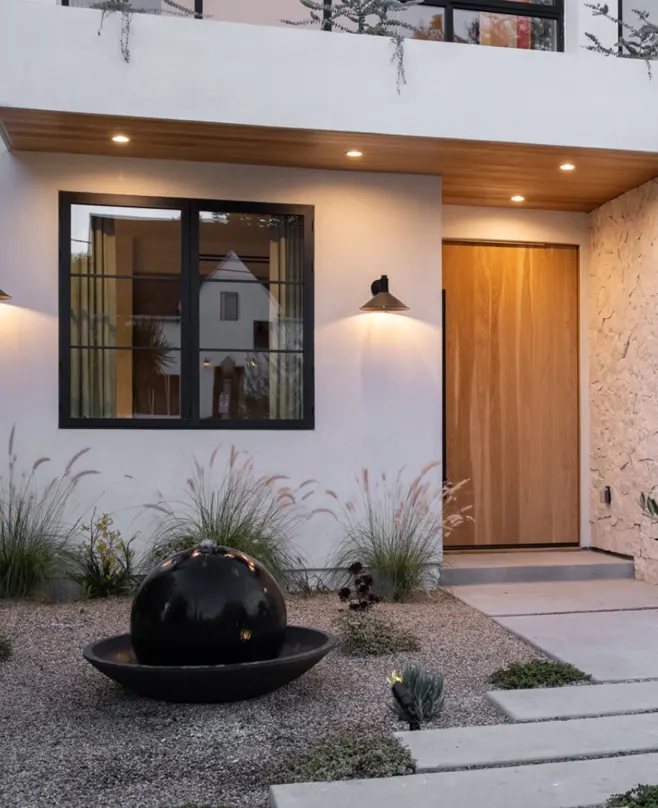
A full house remodel in Los Angeles is a multi-permit, multi-trade project managed under one licensed contractor. That scope is fundamentally different from a room-by-room project — not because of square footage, but because of the permit count.
A whole-home renovation — sometimes called a complete home remodel or gut renovation — covers the majority of a home’s interior at once. Kitchen remodeling, bathroom remodeling as part of a whole-home renovation, living spaces, and MEP systems (mechanical, electrical, plumbing) all get touched in a single coordinated build. Some homeowners also incorporate room additions alongside the renovation when the scope allows.
A full house remodel typically generates four active permits: building, electrical, plumbing, and mechanical (HVAC). Each has its own inspection sequence. Each inspection has to happen in the right order before the next construction phase can begin. IBA Builders holds CSLB License #1074505 — the California credential that legally authorizes us to pull and manage multiple simultaneous permits as the general contractor of record. Itamar Ben Asulin and IBA Builders have managed residential construction projects in LA County since IBA’s founding in 2020.
The six workstreams managed on every whole-home renovation — structural, mechanical, and finish — under one CSLB-licensed contractor of record.
Permit applications sequenced before construction begins — not filed as each trade shows up. The complete stack is planned against the project timeline before demo starts.
No drywall goes up on any phase until the MEP rough-in for that phase has passed LADBS inspection. Missing it means demo and redo — we sequence to prevent that.
Mechanical, electrical, and plumbing replaced or upgraded to current California Building Code and Title 24 standards — not patched to clear minimum inspection.
Where the homeowner stays in part of the home, the phase sequence keeps habitable areas accessible and utility service active throughout construction.
Permits, inspection records, approved plan sets, and change order documentation maintained in one project file. You receive copies at project close.
Framing, plumbing, electrical, HVAC, tile, cabinetry, and finish — all scheduled against the same project timeline. No trade starts until the prior phase’s inspection is signed off.
Full-home site walkthrough before any design. MEP conditions, permit history, structural framing of affected walls, and behind-wall conditions documented. Living displacement plan mapped against project phases.
Building, electrical, plumbing, and mechanical permits filed in the right sequence so all four move toward sign-off in parallel — not stalled behind each other. Design produced to confirmed conditions.
Demolition by phase. Structural and rough-in MEP completed before walls close. Every LADBS rough-in inspection scheduled and passed in sequence. Trades briefed before mobilizing.
Plumbing pressure-tested. Electrical load-tested. HVAC airflow balanced. Anything that won’t pass final is corrected before the inspector arrives — not added to a punch list at the final.
The Sherman Oaks office at 13743 Ventura Blvd sits near the intersection of the 101, 405, and 134 corridors — project sites from Woodland Hills to Silver Lake to the South Bay are reachable within a consistent response window. We work across the San Fernando Valley (Sherman Oaks, Encino, Reseda, Van Nuys, North Hollywood, Woodland Hills), the Westside (Culver City, West LA, Brentwood), Central LA (Silver Lake, Los Feliz, Highland Park), and the South Bay (Torrance, Hawthorne, Gardena). LA housing stock in those areas is heavily concentrated in homes built between the 1950s and 1980s — original wiring, cast iron drain lines, and single-panel electrical that need full replacement when the walls come open. Understanding the structural and permit realities for older LA homes is part of how we approach the diagnostic phase.
On a whole-home renovation, the delays rarely come from construction itself — they come from the inspection sequence. The framing inspection gets scheduled before the rough-in plumbing is complete. The rough-in plumbing passes, but electrical rough-in isn’t ready. The drywall crew shows up before the rough-in inspection is signed off. Now the inspector requires the wall to be opened again. Demo and redo.
“On one whole-home renovation in the Valley, I stepped into a job where the permit applications had been submitted on the same day without mapping the inspection sequence first. Structural permit was complete. Plumbing rough-in wasn’t. Electrical panel was scheduled but the rough-in wasn’t filed. The homeowner had been carrying a crew that couldn’t close walls for six weeks. We rebuilt the inspection schedule from the current state and moved the project from stalled to drywall in three weeks. That’s what permit sequencing looks like when it’s done on purpose, not discovered mid-project.”
— ITAMAR ASSULIN, OWNER, IBA BUILDERS
One licensed contractor of record on a whole-home renovation means one point of accountability for every trade and every permit. You can verify CSLB License #1074505 directly with the state. The LADBS permit process covers building, electrical, plumbing, and mechanical — each with its own inspection sequence. Before signing any agreement, review what to verify before hiring a general contractor in LA. When a wall comes open and reveals something unexpected (deteriorated framing, undersized panel), we document it and bring it to you before proceeding — no items added to the invoice after the fact without a documented conversation first.
Usually four active permits: building, electrical, plumbing, and mechanical (HVAC). Each has its own inspection sequence, and on a whole-home renovation, those sequences have to be planned against each other — not filed in isolation. The number can be higher if structural changes trigger additional engineering review, or lower on more contained projects, but four is the typical baseline for a gut renovation.
Sometimes, depending on the phase sequence. On a true gut renovation where MEP systems are being replaced everywhere at once, occupancy isn’t usually feasible. On a phased renovation where work moves through the home zone by zone, we can often keep one wing or floor habitable with active utility service. Living displacement planning happens during the diagnostic phase — we map which areas can remain occupied during each construction phase and structure the sequence accordingly.
From the first site visit to final inspection, most whole-home renovations on an older LA home run 8–14 months — sometimes longer when structural work or VHFHSZ requirements add review layers. That breaks down roughly as 1–2 months for diagnostics and design, 2–4 months for permit submittal and plan check, and 5–9 months of construction depending on scope and occupancy plan.
It gets documented before any work continues. On an older LA home, behind-wall discoveries are common — deteriorated framing, undersized panels, original cast iron drain lines with internal corrosion. When we find something not in the original scope, we document the condition, the required corrective work, the cost, and the timeline impact. You see all of that before any change is invoiced. Replacing those systems also opens the door to whole-home energy efficiency improvements — insulation, HVAC sizing, and electrical load planning — that are hard to address any other time.
It depends on the existing structure. If foundation, framing, and exterior envelope are sound, a whole-home renovation usually preserves more value than starting over. If the structure has fundamental issues — foundation settlement, severe deferred maintenance, incompatible floor plan that would require relocating most of the framing — custom home building may be more cost-effective. We give you a direct read at the first site visit.
The first step is a site visit — no finalized plan or budget required. We walk the home, review your scope, and identify the permit requirements and MEP conditions that will shape the project. You leave knowing what your full house remodel actually involves: the permit count, the phase sequence, and the realistic timeline. If the existing structure no longer makes sense to work around, our custom home building services may be a better fit. Or review our common questions about whole-home remodel projects before reaching out.