
A custom bathroom built around your actual room — not a showroom reference photo. We map your design concept against real plumbing rough-in locations and door swing clearances first, before any tile or fixture is specified.
CSLB License #1074505
Itamar Ben Asulin on every project
Valley · Westside · South Bay
Custom bathroom remodeling means rebuilding the room from the floor plan outward — not swapping fixtures in place. Most bathroom projects replace what’s already there. Custom is a different scope entirely.
Unlike standard bathroom remodeling in Los Angeles, custom means reconsidering where the shower sits, whether a freestanding tub works in the space, and whether the layout can support a linear drain — the long, narrow floor drain used in curbless shower designs, which requires the entire shower floor to slope toward one edge rather than a center point. It means evaluating where the plumbing rough-in currently sits and deciding what stays and what moves.
Moving plumbing rough-in locations requires a permit in LA. That’s built into every project timeline and budget before design is finalized. You can review LA permit requirements for plumbing work directly through LADBS, and you can verify any CSLB contractor license before signing.
IBA Builders manages custom bathroom work — layout reconfiguration, custom tile, niche and bench construction, fixture-level specification, full wet area waterproofing — under CSLB License #1074505. Owner Itamar Ben Asulin serves as a CSLB-licensed contractor overseeing each project directly. For homeowners who want to understand what to verify before hiring, licensing, permit history, and direct owner involvement are the right places to start. For scope that extends beyond the bathroom, we also handle custom kitchen design and remodeling as part of full-scope interior work.
The six workstreams managed on every custom bathroom project — spatial map through final permit sign-off — under one CSLB-licensed contract.
Room dimensions, plumbing rough-in locations, stud positions, and door swing clearances all confirmed before any design is drawn. Nothing is ordered against an assumption.
Full membrane assembly meeting ASTM C627 tile standards, inspected by LADBS before tile is set. Membrane on all five interior surfaces of every shower niche.
All required plumbing, structural, and building permits pulled under CSLB License #1074505 as contractor of record. You don’t manage city correspondence.
Large-format tiles, book-matched slabs, and diagonal layouts planned around the room’s actual geometry. Cuts mapped before installation begins.
Every shower valve, tub filler, and drain configuration specified against confirmed rough-in locations — not estimated from generic standards.
Shower niches framed to correct depth, waterproofed on all five interior surfaces. Curbless designs with linear drains specified with the right substrate from the start.
Floor plan dimensions, plumbing rough-in locations, wall framing positions, floor substrate condition, and door swing clearances recorded. Permit history pulled. Written summary of buildable vs. requires-modification.
Design tested against the spatial map. Every element answered as buildable as drawn, buildable with modification, or requires a permit for plumbing relocation. Permits filed before any fixture is ordered.
Plumbing rough-in changes happen before substrate is set. Waterproofing system installed and inspected before tile. Niche framing before backer. Custom tile layouts dry-laid before adhesive is applied.
Shower and tub tested under water pressure. Drains confirmed clear and sloped. Curbless shower slope verified with a level. Final LADBS inspection signs off before the project closes.
Custom bathroom scope is most common in higher-end residential neighborhoods — Hollywood Hills, Bel Air, Culver City, West Hollywood, Sherman Oaks, Encino, Los Feliz, Silver Lake, and the South Bay corridor. The projects we see most often share a pattern: the bathroom is a reasonable size, the homeowner has a clear design in mind, but the home was built in the 1960s or 1970s and the plumbing rough-in was set for a standard tub-shower combo — not a custom shower with a bench and a niche. The framing cavities in older shower walls are often narrower than the 3.5 inches a niche requires. We identify that during the pre-design assessment so the solution is in the drawing before tile is selected. Many of these homes benefit from a full house remodel alongside the bathroom work when multiple rooms are being reconsidered together.
Homeowners bring us photos — pulled from a renovation account, a design blog, a magazine spread — and ask if we can build it. The photo shows a stunning bathroom: freestanding tub under a window, large-format tile floor to ceiling, recessed niche centered perfectly between two shower heads. Our first question is always the same: what are your room dimensions?
“Three elements in that one photo each carry spatial requirements. The shower niche — framing between studs at 3.5-inch depth, constrained in a 36-inch shower, opens up in a 60-inch surround. The freestanding tub — needs a floor drain, specific supply rough-in, and clearance for the door swing arc; I’ve walked rooms where the planned tub position would have blocked the door from opening more than 60 degrees. The large-format tile — demands a substrate flat to within 1/8 inch over 10 feet; pier-and-beam foundations in older LA homes can exceed that tolerance. None of these mean the design can’t be built. They mean it has to be tested against the real room before any material is ordered.”
— ITAMAR ASSULIN, OWNER, IBA BUILDERS
Before architectural drawings are prepared, we map your design concept against the existing room. Floor plan measured, plumbing rough-in located, stud positions identified in the shower walls, floor load capacity checked for any freestanding tub, door swing clearance confirmed. That mapping produces a clear answer for each design element — buildable as drawn, buildable with modification, or requires a permit for plumbing relocation. Nothing is ordered against an assumption. Our verified Houzz profile under owner Itamar Ben Asulin’s name documents project photography and client information. For budget and scheduling questions, see common questions about bathroom remodeling timelines and costs.
Maybe — it depends on three things. The floor needs enough load capacity (most slab-on-grade floors are fine; older pier-and-beam may need verification). The supply and drain rough-in have to either already be where the tub will sit or be relocated under a plumbing permit. And the tub position can’t block the bathroom door from opening fully — we draw the door swing arc onto the floor plan and check clearance before any tub is specified. We give you a clear yes/no at the site visit.
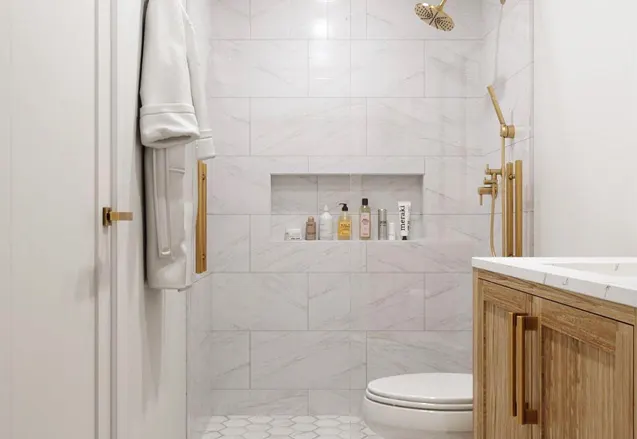
A shower niche is a recessed shelf built into the shower wall for storing shampoo, soap, and other products. It’s framed between the studs at typically 3.5 inches deep, and must be waterproofed on all five interior surfaces before tile is set. The constraint is stud spacing — in a narrow shower wall, the niche width is dictated by the framing cavity. In older LA homes the framing pattern often doesn’t accommodate the niche size from a reference photo, so we design it to the specific dimensions the room actually has.
If any plumbing rough-in moves — shower drain, toilet flange, supply lines, vent stack — a plumbing permit is required, regardless of whether you’re adding or just relocating. A custom layout almost always moves at least one of these, so plan on a plumbing permit for most custom bathroom projects. We file it under CSLB License #1074505 as contractor of record — you don’t manage the city correspondence.
A linear drain is a long, narrow drain channel used in curbless shower designs. Instead of sloping the shower floor toward a center point, the entire floor slopes toward one edge where the linear drain sits. It enables a flush, step-free shower entry — useful for aging-in-place designs, large-format tile floors that look better without a curb, and aesthetic minimalism. It requires a different substrate prep and waterproofing approach than a center drain, so it has to be specified from design — it’s not a swap you make mid-build.
Often yes, but the substrate has to be flat to within 1/8 inch over 10 feet for tiles 24×24 or larger. Older LA homes on pier-and-beam foundations can have floor deflection that exceeds that tolerance — either from settlement, original construction, or both. We check floor flatness during the diagnostic phase. If deflection exceeds tolerance, the fix is a self-leveling underlayment before tile is delivered — not after the first tile comes back with a lippage problem.
A custom bathroom starts with confirming that your design is buildable in your actual room — not approximating it. If you have a reference photo, a sketch, or a list of elements you want, bring it to the first conversation. That’s exactly where we start: mapping what you want against what the room can support. The first step is a site visit. No commitment required.